Cricket has evolved dramatically over the years. While Test cricket remains the traditional longest format of the sport, T20 cricket has transformed the game with its speed, entertainment and aggressive approach.
The debate around Test cricket vs T20 is often presented as a question of which format is better. But the more interesting question is this:
Why do the two formats require such different skills?
Both formats demand excellent batting, bowling, fielding and decision-making. However, the way players utilize those skills changes significantly depending on the format.
What Is the Difference Between Test Cricket and T20?

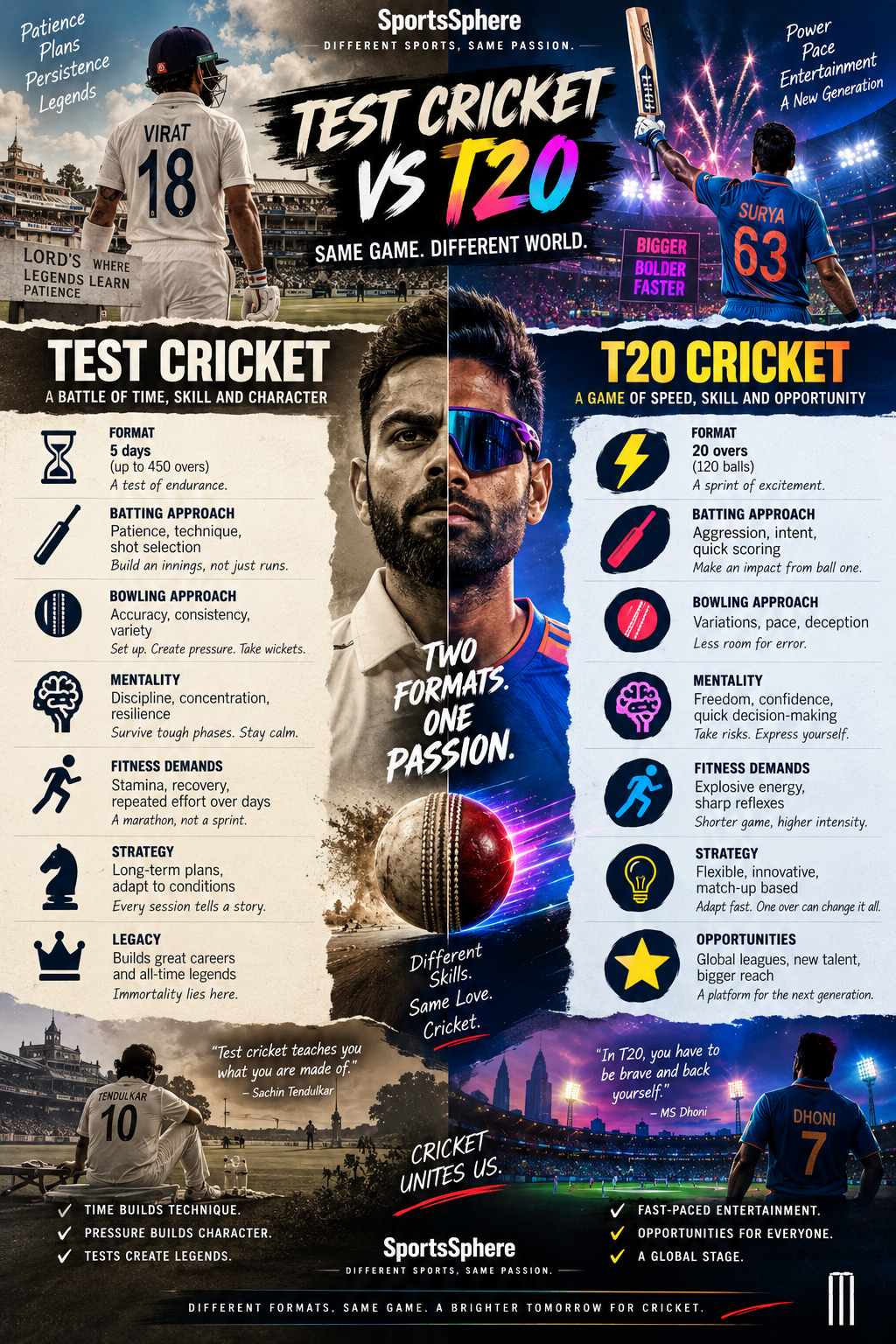
The biggest difference is time.
Test cricket can last up to five days, while a T20 match consists of a maximum of 20 overs per side.
This difference completely changes the strategic approach.
In Test cricket, players have time to build an innings, create pressure gradually and exploit changing pitch conditions.
In T20 cricket, every over matters because there are far fewer opportunities to recover from mistakes.
Test Cricket Demands Patience and Perseverance
One of the most important Test cricket skills is patience.
A batter may need to spend hours at the crease.
The objective is not necessarily to score quickly. It may be to survive difficult periods, wear down the bowling attack and build a substantial innings.
This requires concentration.
A batter must be prepared to leave deliveries outside the off stump, defend accurately and wait for scoring opportunities.
That mental discipline makes Test cricket a unique challenge.
T20 Cricket Demands Immediate Decision-Making
T20 cricket operates at a completely different speed.
Batters have limited deliveries available, so they often need to score aggressively.
A batter cannot always wait for the perfect ball.
They may need to identify scoring opportunities quickly and take calculated risks.
This makes T20 cricket strategy heavily dependent on rapid decision-making.
A player may have only a few balls to change the momentum of an innings.
Bowling Is Different in Both Formats
Bowling also changes significantly between the formats.
In Test cricket, bowlers can build pressure over long spells. They can attack the same area repeatedly and wait for mistakes.
They also have more opportunities to use changes in pace, movement and field placement over time.
In T20 cricket, bowlers have fewer overs and therefore need a clear plan.
Yorkers, slower deliveries, variations and accurate lengths can become important tools.
The margin for error is often much smaller.
Fielding Has Different Demands
Fielding is crucial in both formats, but T20 cricket places enormous emphasis on athleticism and speed.
A single dropped catch or misfield can change a short match dramatically.
In Test cricket, fielders must maintain concentration over much longer periods.
A player may spend hours waiting for a chance before suddenly needing to make an important catch.
Therefore, both formats demand elite fielding—but the psychological challenge is different.
Fitness and Endurance
The physical requirements also vary.
Test cricket demands endurance because matches can continue for several days.
Players must recover between innings and remain physically prepared for long periods.
T20 cricket is shorter but can be extremely explosive.
Players may need to sprint, dive, throw and react repeatedly during a highly intense period.
Therefore, cricket fitness is essential in both formats, although the type of physical demand differs.
Cricket Mentality Changes With the Format
Mental strength is perhaps one of the most fascinating differences between Test cricket and T20.
Test cricket rewards patience, concentration and resilience.
T20 rewards aggression, confidence and the ability to recover instantly from mistakes.
A T20 batter can be dismissed attempting a big shot and may have only a short period to think about the failure.
A Test batter may have to remain mentally focused for several hours.
Both situations require strong cricket mentality, but they test the mind differently.
Which Format Is Harder?
There is no simple answer.
Test cricket is demanding because of its duration, patience and requirement for sustained concentration.
T20 cricket is demanding because players must make high-pressure decisions extremely quickly.
A player who excels in one format does not automatically dominate the other.
Different formats reward different strengths.
How Strategy Changes
In Test cricket, captains can plan several overs or even sessions ahead.
Field placements can evolve slowly depending on the batter and match situation.
In T20 cricket, captains often need to make decisions much faster.
Bowling changes, field placements and batting orders can influence the game within minutes.
This is why cricket strategy is so fascinating: the same sport can require completely different tactical thinking depending on the format.
Conclusion
The debate around Test cricket vs T20 should not simply be about which format is superior.
They represent two different versions of cricket.
Test cricket celebrates patience, endurance, technique and long-term strategy. T20 cricket celebrates speed, innovation, aggression and rapid decision-making.
Both formats challenge players in different ways, and that diversity is one of cricket’s greatest strengths.
Whether you enjoy a long Test match or an explosive T20 encounter, the fundamentals remain the same: skill, strategy, discipline and the ability to perform under pressure.
SportsSphere — Different Sports, Same Passion.