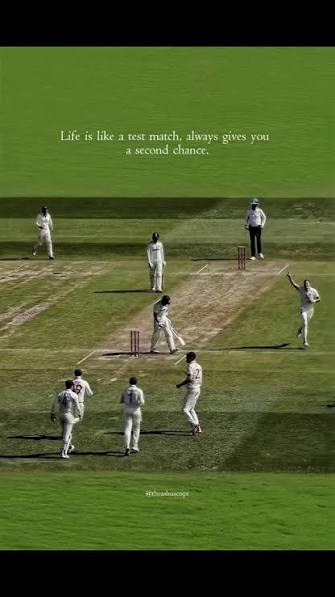
The Beauty of Test Cricket: What Five Days of Patience Can Teach Us About Life
In a world where everything is becoming faster, Test cricket asks us to slow down.
Five days. Two teams. Hundreds of overs. Moments of brilliance followed by periods of frustration, uncertainty and waiting. At first glance, Test cricket can seem almost out of place in today’s world of instant entertainment. But that is precisely what makes it special.
Test cricket is not simply about runs, wickets and results. It is a test of patience, concentration, resilience and character. It is perhaps the closest form of cricket to life itself—because just like life, it rarely gives us immediate answers.
Yet the longest format of cricket is facing an uncomfortable reality: its popularity is under pressure.
With T20 cricket offering explosive entertainment in just a few hours, Test cricket’s five-day commitment can appear demanding to modern audiences. The International Cricket Council continues to promote Test cricket through competitions such as the World Test Championship, showing that the format remains an important part of international cricket.
But why does Test cricket still matter?
Test Cricket Is More Than Just a Game
The beauty of Test cricket lies in its unpredictability.
A team can dominate for two days and find itself in trouble on the third. A batsman can spend hours building an innings before one mistake changes everything. A bowler can endure spell after spell before finally finding the delivery that produces a wicket.
There is no shortcut.
In T20 cricket, a few overs can completely transform a match. In Test cricket, the story develops slowly. Sessions matter. Partnerships matter. The condition of the pitch matters. Weather matters. Even the time of day can influence the contest.
It creates a sporting narrative rather than simply a sporting spectacle.
And that narrative is what makes Test cricket beautiful.
The Beauty of Waiting
One of the greatest lessons of Test cricket is the value of waiting.
A fast bowler may bowl several overs without taking a wicket. A batsman may defend dozens of deliveries before finding an opportunity to score. A captain may spend hours setting the perfect trap for an opposition batsman.
The reward does not always come immediately.
Life works in much the same way.
We study without immediately seeing results. We constantly work without instantly receiving recognition. We fail, we try again and sometimes wait years before achieving something meaningful.
Modern life often encourages instant gratification. Test cricket represents the opposite philosophy.
It tells us that some things are worth waiting for.
Test Cricket Is a Reflection of Life
Perhaps the most fascinating thing about Test cricket is how closely it resembles human life.
Patience
Test cricket rewards people who can remain focused even when nothing seems to be happening.
A batsman cannot attack every ball. A bowler cannot expect every delivery to produce a wicket. Sometimes the best decision is simply to wait and wait and that develops the tolerance level.
Life is similar.
Not every opportunity needs to be chased immediately. Sometimes progress means staying disciplined when results are invisible.
Failure
Failure is unavoidable in Test cricket.
Even the greatest batsmen in history have been dismissed for low scores. The greatest bowlers have gone wicketless. Teams that appear unbeatable have suffered dramatic defeats.
The format teaches an important lesson: one failure does not define the entire story.
A batsman dismissed cheaply in the first innings can return in the second and score a century. A bowler who struggles in the morning can become decisive in the final session.
There is always another chapter.
Resilience
Test cricket can demand extraordinary mental strength.
Players may spend hours under pressure, knowing that one mistake could change the match. They have to recover from bad sessions, poor decisions and difficult conditions.
That resilience is one of the reasons Test cricket has produced some of cricket’s most memorable performances.
It is also one of the qualities that life demands from us.
Adaptation
Conditions change constantly during a Test match.
The pitch can deteriorate. The ball can move differently. The weather can change. A batsman’s technique may need to adapt as the match progresses.
Successful players understand that yesterday’s strategy may not work today.
Life demands the same flexibility.
What worked for us five years ago may not work today. Circumstances change, and survival often depends on our ability to adapt.
The Importance of Time
Perhaps the biggest lesson of Test cricket is that time itself can be valuable.
In a culture obsessed with speed, Test cricket reminds us that meaningful things do not always happen quickly.
A great innings can take hours.
A comeback can take days.
A victory can sometimes require patience until the very final session.
That makes Test cricket almost philosophical.
Why Is Test Cricket Losing Its Popularity?
Despite its beauty, Test cricket faces a major challenge.
Modern audiences have more entertainment choices than ever before. People can watch a T20 match in approximately three hours, follow short-form videos on social media, stream movies instantly or consume sports highlights within minutes.
Test cricket demands something different: time and attention.
That is a difficult proposition in an increasingly distracted world.
There is also a financial dimension. T20 leagues have created enormous commercial opportunities for players, broadcasters and franchises. Their shorter format makes them easier to schedule, package and sell as entertainment.
Test cricket, by comparison, requires greater investment of time from everyone involved.
This does not necessarily mean that Test cricket is dying.
It means the format has entered a new era in which it must compete for attention.
T20 Changed the Way We Consume Cricket
T20 cricket has not necessarily become the enemy of Test cricket.
Instead, it has changed what cricket audiences expect.
T20 offers immediate action. Sixes, wickets, strategic timeouts, aggressive batting and constant momentum make it highly accessible.
Test cricket asks audiences to appreciate something different.
It asks them to notice the subtle battle between bat and ball. It asks them to understand why a defensive shot can be as important as a boundary. It asks them to appreciate a bowler creating pressure over several overs.
T20 gives us instant excitement.
Test cricket gives us a story.
Both can exist.
The challenge is ensuring that one does not completely replace the other.
Is Test Cricket Becoming a Victim of Modern Life?
This may be the most important question.
Perhaps Test cricket’s problem is not that it has become less interesting.
Perhaps we have become less patient.
We live in an age of instant messages, instant entertainment and instant information. We can order food within minutes, watch an entire season of a television series in a weekend and scroll through hundreds of pieces of content in an hour.
Then comes Test cricket.
It tells us to sit down.
Watch.
Wait.
Observe.
Understand.
Maybe that is why Test cricket can feel strange today.
And maybe that is exactly why it remains valuable.
Why Test Cricket Still Matters
Test cricket represents a side of sport that is difficult to reproduce in shorter formats.
It allows rivalries to develop over years. It gives players time to demonstrate technique and temperament. It creates room for tactical battles that can unfold across multiple days.
The format also preserves cricket’s deepest traditions.
The white clothing. The red ball. The morning start. The changing conditions. The pressure of the final innings. The possibility that a match can move dramatically in one session.
These are not merely traditions.
They are part of cricket’s identity.
The World Test Championship has also provided international Test cricket with a greater sense of structure and context, giving teams a long-term objective beyond individual bilateral series.
Can Test Cricket Survive?
Yes—but it cannot simply depend on nostalgia.
Test cricket needs to remain accessible to younger audiences. Better digital storytelling, shorter highlights, engaging social-media content and stronger promotion can help introduce new viewers to the format.
The game also needs to preserve its identity while adapting to modern consumption habits.
The answer should not be to turn Test cricket into T20.
Its strength is precisely that it is different.
Instead, cricket should make people understand why that difference matters.
A five-day match should not be sold merely as five days of cricket.
It should be presented as five days of drama.
Final Thoughts: Maybe We Need Test Cricket More Than Ever
The decline in Test cricket’s popularity should concern cricket lovers, but it should also make us think about something beyond sport.
Test cricket represents patience in a world that increasingly demands speed.
It represents resilience when instant success is expected.
It represents failure without the finality of a single moment.
And most importantly, it reminds us that some of life’s greatest stories take time to unfold.
A Test match does not always give you excitement every minute.
Neither does life.
There are quiet periods. There are setbacks. There are days when nothing seems to go according to plan.
But if you stay long enough, keep adapting and refuse to give up, the story can change.
That is the beauty of Test cricket.
Perhaps the format does not need to become faster.
Perhaps we simply need to remember how to slow down and appreciate it.